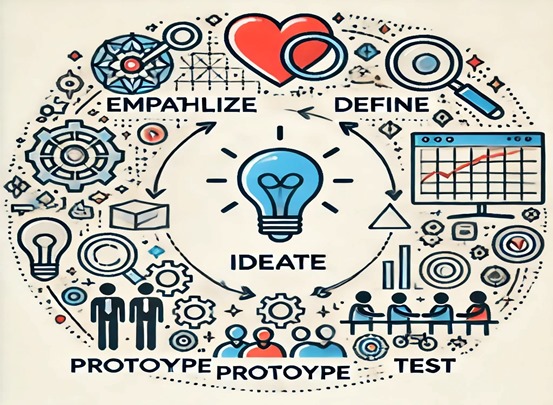
Stage 3. Ideate: Generate Ideas
- How: Brainstorming is one of the common ways of generating creative solutions that address the problem. When brainstorming, encourage diverse thinking and idea generation from different standpoints. Brainstorming in a group can help to generate more diverse ideas.
Focus on Feasibility and Impact: Ensure that ideas are practical, scalable, and have the potential to create meaningful change in the food system. Select 3-4 viable ideas.
Example:
Ideas could include solar-powered cold storage systems for rural areas, affordable packaging to reduce spoilage, or mobile platforms for connecting farmers with markets.
How to choose a good idea
There are many different techniques that you can use to select the best idea from a pool of many that you or your group has developed. Only three are presented in this course.
Dot Mapping
This technique involves the group members voting for the ideas that have been generated. The ideas are written on sticky notes and pinned on the wall. Each member is given equal number of votes and can vote for their best idea as many times as they like by putting a dot on the idea. The idea that receives the highest number of dots is the most popular.
Affinity mapping
This technique involves grouping similar ideas together. Below is a step by step process of doing affinity mapping.
Write each idea on a separate sticky note
Stick the first idea on the wall or flat surface
Take the next idea and decide if it has a similar theme to the first. If working in a group discuss and agree
If similar stick together with first. If different stick on a different location on the wall
Repeat steps ‘c’ and ‘d’ for all the ideas
Finally, give a theme that summarizes ideas in each group
Through affinity mapping you and your group can identify popular solutions to a problem.
Effort/Impact Matrix
This technique helps you and your group to rate viability of ideas generated. Below are the steps for carrying out effort/impact analysis.
1. Draw a big square on a flat surface and label the top of one-line High Impact and the bottom Low Impact. Label the top of another line High Effort and the bottom Low Effort.
2. Divide the square into four smaller squares. Depending on the location on the squares on the axis, name them as shown in the picture below.
3. Pick one idea at a time and discuss with your group how much effort it will require to execute it.
4. Holding the sticky note decide how much impact the idea could have and place it in the box that feels right on the impact axis.
5. Repeat for all ideas until they are all placed in the matrix

NB: The best ideas are those that require low effort but make high impact. Short list 3-4 ideas.
Stage 4. Prototype: Build Models
Prototyping is a way of thinking by making. They can be physical or digital models of the ideas generated in the ideation phase. You can draw/sketch, create something from an old cardboard, model with plasticine, write a story board.
Examples:
A mobile app that connects farmers with buyers to reduce food waste.
A prototype of a sustainable packaging system that extends shelf life.
Advantages of developing prototypes
Makes it easy to explain ideas to people
Helps to get valuable feedback about an idea
They are cheap to make and can help to avoid costly mistakes. Imagine what a waste of time and resources spent in developing a flawed idea.
Take note of the feedback you receive in this stage to refine the prototype.
There are various types of prototypes such as paper prototypes, low fidelity and high fidelity prototypes.
Stage 5. Test: Refine Solutions
Test your prototypes with actual users and gather feedback for refinement.
Test Prototypes with Users: Engage directly with end-users of your product to test solutions in real-world environments.
Make changes Based on Feedback: Use the feedback gathered to refine and improve the prototype.
Examples:
Testing a cold storage prototype with farmers to see if it effectively reduces food spoilage.
Piloting a food distribution app to assess its impact on market access for small-scale producers.
Stage 6. Implement: Scale and Evaluate
Objective: Implement the final solution at scale and evaluate its impact.
Scale Successful Solutions: After refining the prototype, implement it on a larger scale to address broader food system challenges.
Measure Impact: Use key performance indicators (KPIs) to evaluate the solution’s effectiveness in areas like food security, farmer income, or sustainability.
Examples:
Scaling a low-cost irrigation system for small farmers to improve crop yields.
Design Thinking in Action for Food System Innovations
Post-Harvest Loss Reduction: Solutions can include better storage techniques, transportation methods, or tracking technology.
Nutrition and Health: Design fortified foods or affordable meal kits that tackle local nutritional issues.
Sustainable Farming: Develop tools or processes that foster sustainable practices, enhance productivity and profitability, and ensure effective management of natural resources.

Conclusion
By applying Design Thinking to food system innovations, you can develop user-centered, sustainable solutions that address complex issues within agriculture, food distribution, and nutrition. This approach promotes collaboration, creativity, and a deep understanding of user needs, ensuring that the innovations created are practical and scalable.
.png)